Email marketing remains one of the most powerful digital marketing channels for event promotion. Whether you’re organizing a medical conference, healthcare webinar, corporate seminar, product launch, workshop, or community event, email marketing helps you reach the right audience directly in their inbox and encourages them to register and attend.
With the rise of AI-powered search, answer engines, and personalized customer experiences, event marketers must go beyond traditional email campaigns. Modern email marketing strategies should be optimized for SEO, AEO (Answer Engine Optimization), GEO (Generative Engine Optimization), AIO (AI Optimization), SXO (Search Experience Optimization), and LMO (Language Model Optimization).
This guide explains how to use email marketing effectively to maximize event registrations and attendance.
Email marketing offers several advantages over other promotional channels:
According to industry studies, email consistently delivers one of the highest returns on investment among digital marketing channels, making it ideal for promoting events of all sizes.
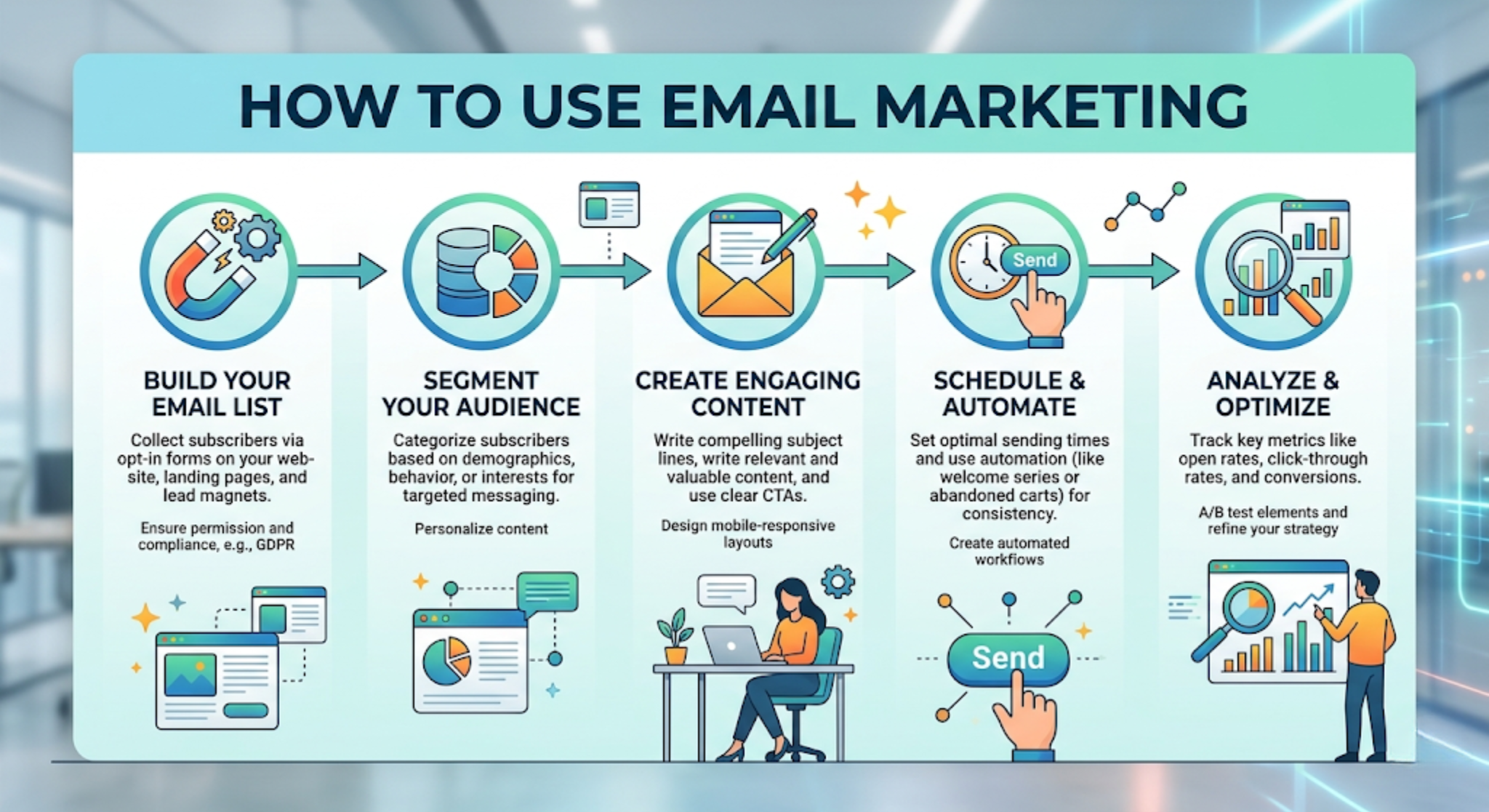
The success of your event campaign depends on the quality of your email list.
Focus on:
Avoid purchasing email lists. Organic and permission-based subscribers are more likely to engage with your event invitations.
Not every subscriber should receive the same email.
Audience segmentation helps deliver relevant content based on:
Personalized emails significantly improve open rates and registrations.
Your invitation email should immediately answer:
Examples:
Clearly communicate the event value.
Example:
“Learn Advanced Medical Marketing Strategies from Industry Experts”
Include:
Examples:
Successful event promotion relies on multiple touchpoints.
Send 4–6 weeks before the event.
Purpose:
Introduce the event and open registrations.
Send 1 week later.
Purpose:
Highlight key takeaways and speaker expertise.
Share:
Create urgency around discounts or limited seats.
Send 24–48 hours before registration closes.
Send 1 day before the event.
Send 1 hour before the event starts.
Modern consumers expect personalized communication.
Include:
Example:
Instead of:
“Dear Subscriber”
Use:
“Hi Sarah, here’s why this healthcare conference could benefit your practice.”
Personalization improves click-through rates and event registrations.
Most emails are opened on smartphones.
Ensure:
A poor mobile experience can significantly reduce registrations.
People are more likely to act when they fear missing out.
Use phrases like:
Urgency encourages immediate action.
Trust influences attendance decisions.
Include:
Share attendee experiences from previous events.
Highlight expertise and achievements.
Examples:
Social proof builds credibility and increases conversions.
Monitor key email marketing metrics:
Measures subject line effectiveness.
Measures audience interest.
Tracks actual event sign-ups.
Measures completed registrations.
Indicates audience relevance.
Use insights to improve future campaigns.
The event doesn’t end when attendees leave.
Follow-up emails can:
Post-event engagement strengthens long-term relationships.
Most successful event campaigns use 5–7 emails before the event and 1–2 follow-up emails afterward.
Start promoting major events 4–8 weeks in advance, depending on audience size and event type.
Tuesday, Wednesday, and Thursday often produce the highest engagement rates, though testing is recommended.
Use audience segmentation, compelling subject lines, personalized content, social proof, and urgency-based CTAs.
Popular platforms include Mailchimp, HubSpot, ActiveCampaign, Brevo, ConvertKit, and Constant Contact.
As AI continues to influence digital marketing, event marketers should focus on:
Businesses that adopt these strategies will achieve higher attendance and engagement rates.
Email marketing remains one of the most effective ways to promote events and increase attendance. By building targeted email lists, segmenting audiences, creating personalized campaigns, using automation, and optimizing for user experience, organizations can significantly improve event registrations and ROI.
In today’s AI-driven digital landscape, combining traditional email marketing best practices with SEO, AEO, GEO, AIO, SXO, and LMO optimization ensures your event promotion strategy stays competitive and future-ready.
A multi-email sequence that includes announcements, reminders, social proof, urgency messages, and follow-ups delivers the best results.
Typically 4–8 weeks before the event, depending on its size and audience.
Yes. Email marketing remains one of the highest-converting channels for event registrations and attendee engagement.
Use compelling subject lines, personalization, audience segmentation, and optimized send times.
Absolutely. Reminder emails significantly reduce no-shows and improve attendance rates.
Ready to boost attendance at your next event?
Our expert digital marketing team can help you create high-converting email campaigns, automated workflows, audience segmentation strategies, and event marketing funnels that drive registrations and maximize ROI.
Contact us today to discover how strategic email marketing can make your next event a success.